Procedure
Breast Revision Surgery in Cyprus
Revision surgery corrects or improves the result of a previous breast augmentation — most often by exchanging the implants, but also to treat capsular contracture, malposition, rupture or scarring. It is a more complex operation than the original augmentation.
Procedure facts
- Duration
- 1–2 hours
- Anaesthesia
- General
- Hospital stay
- 1 night
- Pre-admission tests
- Blood tests
- Downtime
- 1–2 weeks
- Driving
- A few days
- Exercise
- 1 month
- Final result
- 2–3 months
Overview
Breast revision surgery corrects or improves the result of a previous breast augmentation, most often by replacing the existing implants with new ones.
Implants and the breast tissue over them change over time, and the result can come to look and feel different from the original one. Patients should expect that implants will need attention at some point rather than lasting indefinitely.
The most common single reason for revision, though, is simply a wish to change the size or shape of the breast, in either direction. Where that is the case, a breast lift is often carried out at the same time.
Why patients have revision surgery
Beyond dissatisfaction with the original result, reasons include:
- Complications after augmentation — hypertrophic scarring, rippling, capsular contracture, double-bubble deformity, symmastia, asymmetry between the two breasts, implant malposition
- Changes to the body that make a different size or shape preferable — an implant exchange
- Distortion of breast shape where the scar from the augmentation has tightened and is compressing the implant
- Rupture or migration of an implant
- Pain from capsular contracture
- A change from saline to silicone implants
- A nipple that sits too high with the implant too low
The procedure is also known as breast reoperation, breast augmentation revision and breast implant replacement.
Types of revision
A treatment plan may involve one of the following, or a combination.
Removal and replacement of implants The existing implants are removed and replaced with implants better suited to the patient’s body and expectations. The new implants may differ in shape, size and type, and adjustments to the implant pocket may be needed.
Implant removal, with or without a breast lift Some patients wish to have implants removed altogether — after weight gain, with age, or by preference. Removing the implants leaves the breast flat and deflated, so a lift is often appropriate at the same time to reshape the remaining tissue.
Revision of scars Poor healing after augmentation can leave enlarged or stretched scars, and their revision may be the main purpose of the operation.
Capsulectomy for capsular contracture Where the scar capsule around the implant has contracted, it changes the position or shape of the implant. The implant becomes firm, rippling becomes apparent and the patient may have discomfort or pain. The capsule is removed to address this.
Correction of submuscular implant deformity Intense upper-body exercise can displace a submuscular implant or change its shape. The pectoralis major is returned to its anatomical position on the chest wall and new implants are placed above the muscle.
What the operation involves
Anaesthesia is general, administered by a consultant anaesthetist.
The incision depends on the type of revision planned, and is chosen around the size and type of implant and the patient’s anatomy.
Inframammary fold (IMF) The most common and generally preferred approach, giving direct access to the muscle and to the pocket in which the new implant is placed.
Periareolar Placed at the junction between the darker areolar skin and the lighter skin of the breast.
Transaxillary A small incision in the armpit, through which the implant is exchanged using a camera and specialised instruments. The thin skin of the axilla forms natural creases and shadows that conceal the scar.
The incision is then closed in layers.
Recovery
Recovery depends on the incision used. A compression bra and chest band are worn immediately after surgery to limit movement of the implant and maintain the pocket that has been created.
Keep arms and elbows close to the sides and avoid lifting until permitted. Light everyday activity resumes gradually after two to three days. Most patients return to work and to physical activity after two weeks, beginning with lower-body exercise and building up to upper-body work.
The result continues to improve as the implants settle into position. Results are long-term, though changes in body weight, ageing and pregnancy may alter the appearance of the breast.
Patients heal at different rates. Post-operative instructions should be followed closely for at least a month after surgery.
Where the surgery takes place
Dr. Stavrou performs breast revision surgery in accredited medical centres in Cyprus (Nicosia and Limassol), Greece (Athens) and Malta (Sliema). After the procedure the patient is transferred to the recovery suite and monitored by the clinical team.
Risks and considerations
Revision breast surgery is generally more complex than a first operation, because it works within tissue and scarring already altered by previous surgery. It carries the general risks of surgery and, where implants are involved, the implant-specific risks of capsular contracture, rupture and, rarely, BIA-ALCL. Scarring from the earlier operation may be reused or extended, and the final scar can differ from the original. Correcting asymmetry, implant position or a capsular problem is worked towards rather than guaranteed, and in some cases more than one further procedure is needed. Because every revision starts from a different surgical history, the realistic aims and limits are assessed individually at the consultation.
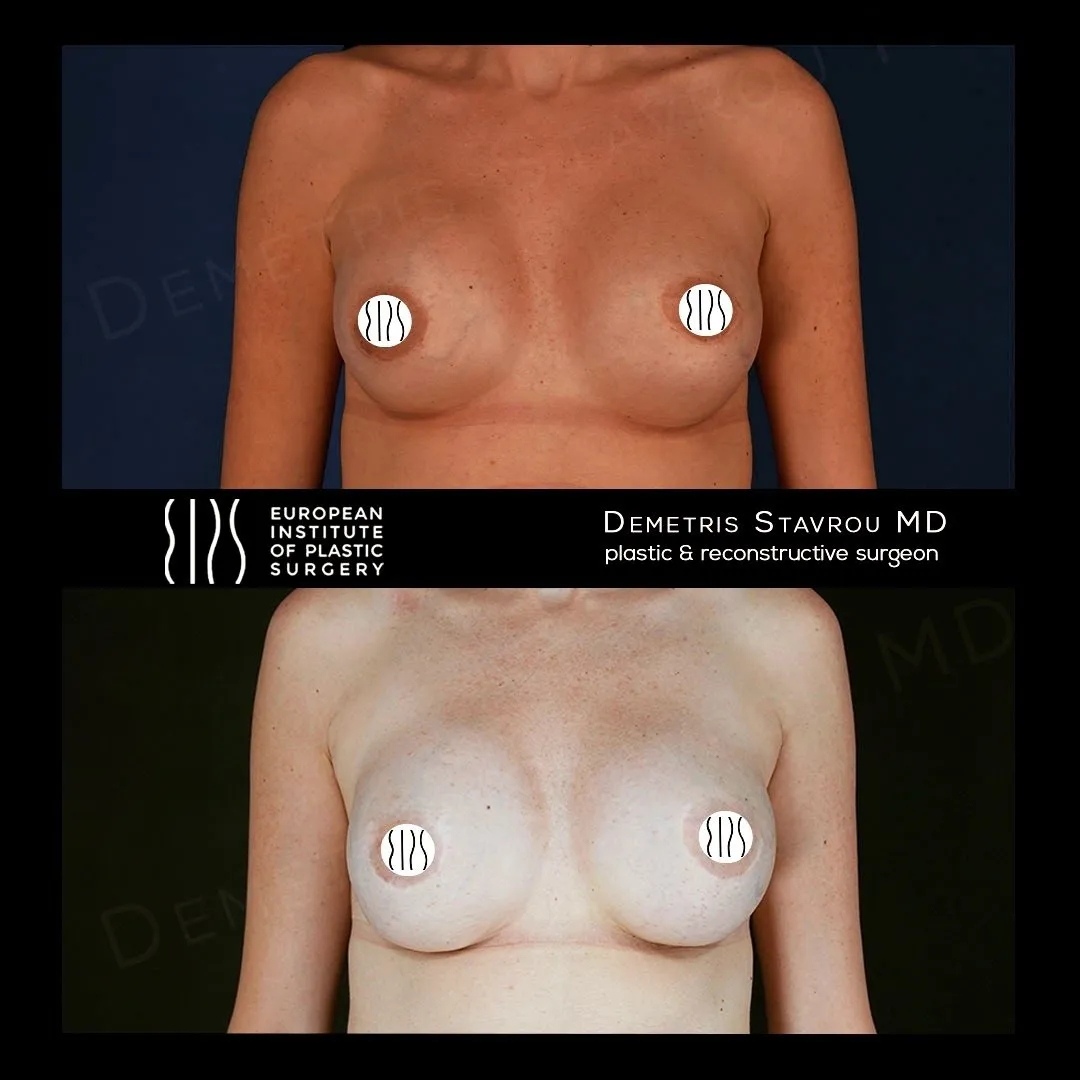
Before and after
1 case published with the patient's written consent. These are individual results, not an average and not a guarantee.
Questions patients ask
Should I have a breast revision?
Revision may be appropriate where implants placed some time ago no longer look as the patient wants them to, or where there has been a complication after the original augmentation. Common reasons include a change of implant shape, size or type; removal of implants by preference; implant migration or bottoming out; capsular contracture; folding or rippling; a deflated or ruptured implant; asymmetry between the breasts; change after weight loss, pregnancy or breastfeeding; and replacement of older implants. Assessment covers the breasts, medical history, body shape and skin quality.
How long does breast revision surgery take?
Between 30 and 150 minutes, depending on the incision and the implant placement involved.
Is breast revision surgery painful?
Whether it is more or less uncomfortable than the original augmentation depends on the specifics of the procedure, including the incision used. It is normal to experience manageable pain during recovery, and pain medication is prescribed, particularly for the first two to three days.
Is breast revision surgery safe?
Revision is a more complex operation than a first augmentation. It is safe when performed by an experienced, board-certified plastic surgeon, and patients should follow the pre-operative and post-operative instructions they are given.
Can breast implant revision provide a lift?
New implants improve size and shape but do not correct sagging. Where there is ptosis, revision can be combined with a breast lift in the same operation. Combining them means fewer incisions and therefore fewer scars, correction of both the implant and the sagging at once, and a single period of recovery instead of two.
Can you drive the day after breast implant revision?
No. Arrange for someone to drive you home on the day of surgery. Most patients are able to drive again about a week afterwards.
Where it is performed
- Surgery in Cyprus
- The Surgery Center 3i, Strovolos
- Surgery in Athens
- Iatriko Athinon, Marousi Mediterraneo Hospital, Glyfada
Where yours takes place is agreed at the consultation.
How we quote
A quotation follows consultation, because what it costs depends on what the operation actually involves for you — the technique, the time in theatre, and whether anything is being addressed at the same time. We do not publish price lists and we do not quote before examining you.
Arranging a consultation
Book a slot in the clinic diary directly, or send the details of what you are considering and we will reply with the times we have.